
Carbon vs Aluminium Arrows: Which Should You Shoot?
Carbon vs aluminium arrows compared: weight, stiffness, durability, straightness, consistency, safety checks, cost and which suits target, hunting or youth.

By Archery Insider Editorial Team
· · 7 min read
Research-based: built from maker specs and official sources, fact-checked before publishing. How we review products
In this article
Walk along any shooting line and you will see two kinds of arrow: dull grey or coloured aluminium tubes, and slim black carbon shafts. A few archers shoot a hybrid of both, and traditional archers still shoot wood. Each material behaves differently in the bow, in the target and when something goes wrong.
This comparison explains how carbon and aluminium arrows differ, what that means for accuracy, durability and safety, and which is the better choice for beginners, youth, target archers, indoor shooters and hunters.
The quick answer
| If you are... | Usually choose |
|---|---|
| A beginner on a light recurve | Aluminium |
| Buying for a child | Aluminium (light spines and short lengths available) |
| Shooting outdoor target archery at 50 to 70 metres | Carbon or aluminium-carbon |
| Shooting indoors at 18 metres for score | Large-diameter aluminium (or large-diameter carbon) |
| Bowhunting with a compound | Carbon |
| Shooting a longbow in traditional competition | Wood (often required by the rules) |
How the two materials differ
Aluminium
Modern aluminium arrows are drawn tubes of high-strength alloy. Easton's entry-level XX75 Jazz, for example, is made from 7075 aerospace alloy with a hard-anodised finish, a straightness tolerance of ±0.005 inch and a weight tolerance of ±2 percent. Aluminium sizes use a four-digit code: a 1816 shaft is 18/64 inch in diameter with a 0.016-inch wall.
Aluminium is dense and uniform, which is why a dozen aluminium arrows from one batch are very consistent in weight and spine. Its weakness is that it bends: a glancing blow off a target frame or another arrow can leave a shaft slightly kinked.
Carbon
Carbon arrows are made from carbon fibre and resin, wrapped or pultruded into a tube. Carbon is much stiffer for its weight than aluminium, so a carbon arrow of a given spine is usually lighter and thinner. Carbon shafts are sold in straightness grades; Gold Tip's Hunter XT, for example, is a ±0.003-inch shaft with a ±2-grain weight tolerance.
Carbon does not bend. It either stays straight or it breaks, which is why carbon arrows hold their straightness so well over time, and also why a damaged carbon arrow must be retired rather than repaired.
Aluminium-carbon composites
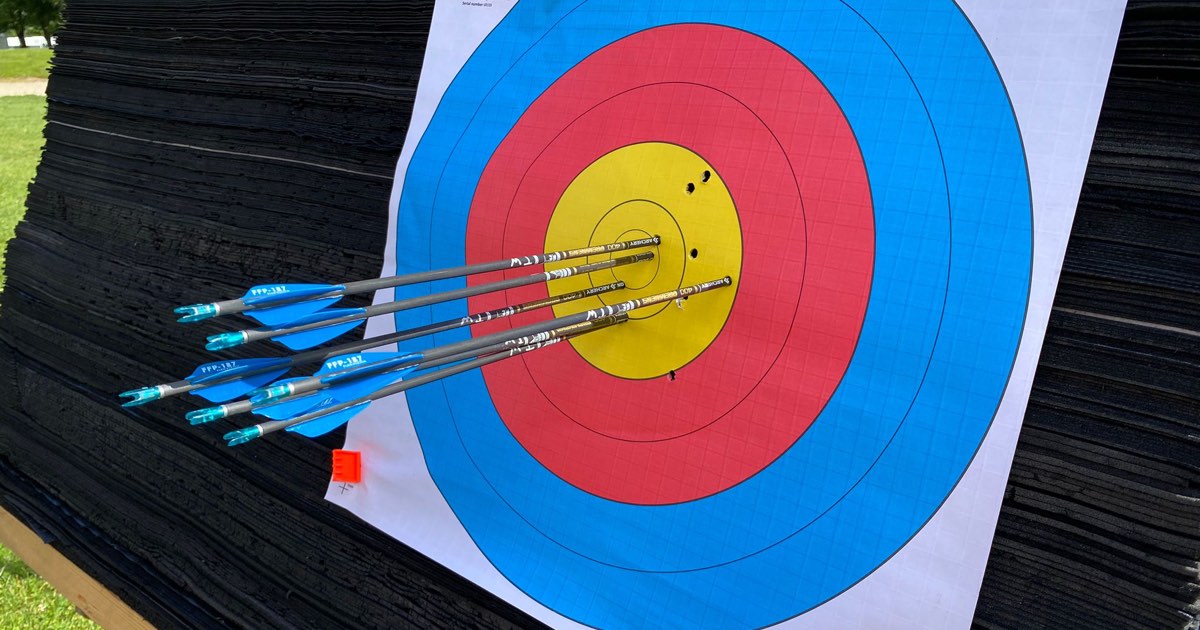
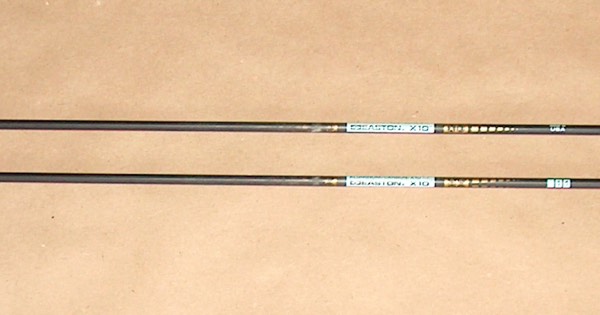
Composite shafts bond carbon fibre over a thin aluminium core. The best known is the Easton X10, high-modulus carbon on a precision 7075 aluminium core. Easton states that it has won more World and Olympic titles than any other arrow since its debut at the Atlanta 1996 Olympic Games. Composites aim to combine aluminium's consistency with carbon's light weight and small diameter, and they are mainly used by elite recurve archers.
Side-by-side comparison
| Aluminium | Carbon | |
|---|---|---|
| Weight for a given spine | Heavier | Lighter |
| Diameter for a given spine | Larger | Smaller |
| Straightness over time | Can be bent; can often be straightened | Holds straightness; does not bend |
| Failure mode | Bends | Cracks or splinters |
| Consistency within a set | Very consistent | Depends on grade; premium shafts very consistent |
| Light spines for children | Widely available | More limited |
| Wind drift outdoors | More (larger diameter) | Less (smaller diameter, lighter) |
| Indoor line-cutting | Excellent in large diameters | Large-diameter carbon also available |
| Typical users | Beginners, youth, indoor shooters | Hunters, outdoor target archers |
Weight, speed and trajectory
A lighter arrow leaves the bow faster and drops less over distance. For outdoor target archery at 50 or 70 metres, that flatter trajectory makes sight marks easier and reduces the effect of small distance errors. This is why outdoor target archers moved to carbon and composites.
Heavier arrows are slower but carry more momentum and are generally quieter on release. Some hunters deliberately build heavier carbon arrows with heavy inserts and points, rather than switching back to aluminium.
Diameter and wind
Thinner shafts present less surface to a crosswind. Outdoors, small-diameter carbon arrows drift less than larger aluminium shafts of the same spine, which matters at long distances.
Indoors the logic reverses. An arrow scores the higher ring if its shaft touches the line, so a fatter shaft "cuts" more lines. Easton's X23 indoor aluminium arrow has a 23/64-inch (0.359-inch) outside diameter, close to the World Archery limit: the maximum shaft diameter in World Archery competition is 9.3 mm. Our scoring guide explains line cutters.
Durability and safety
Aluminium
- Bends on hard impacts. Lightly bent shafts can often be straightened with an arrow straightener, but repeated straightening weakens the tube.
- Fails safely in the sense that a bent arrow is obvious; it wobbles when rolled on a flat surface.
Carbon
- Does not bend, so it stays straight until it is damaged.
- Can crack after hitting something hard, or after being hit by another arrow. A cracked carbon arrow can break on release and drive splinters into the bow hand.
Spine availability and children
Very light bows need very flexible arrows. Aluminium is made in small, light sizes such as the 1214 and 1416 sizes in the Easton Jazz range, which suit youth bows in the teens of pounds. Carbon ranges increasingly include light spines, but aluminium remains the most common choice for children's and beginners' equipment. Our guide to choosing a bow for a child covers arrow sizing for young archers.
Cost
Prices change and vary by retailer, so we do not quote them. In general, entry-level aluminium and entry-level carbon arrows overlap in cost, while premium grades in both materials, and composites such as the X10, cost considerably more. The practical cost difference is in what happens when an arrow is damaged: a bent aluminium shaft may be straightened, while a damaged carbon shaft is replaced.
Aluminium arrows
Advantages
- Very consistent weight and spine within a set
- Light spines and short lengths for children and beginners
- Bent shafts can often be straightened
- Large diameters for indoor line-cutting
Trade-offs
- Heavier for the same stiffness
- Larger diameter drifts more in wind
- Bends on hard impacts and loses straightness
- Repeated straightening weakens the shaft
Carbon arrows
Advantages
- Lighter for the same stiffness; flatter trajectory
- Small diameter reduces wind drift
- Holds straightness; does not bend
- Wide range of hunting and target shafts
Trade-offs
- Can crack and must be inspected after impacts
- Damaged shafts must be replaced, not repaired
- Very light spines less widely available
- Small-diameter shafts need matching components
Which should you choose?
Beginners and club archers
Start with aluminium cut to the correct length and spine. It is consistent, forgiving of the knocks that come with learning, and repairable. Our Easton XX75 Jazz review covers a typical first set.
Outdoor target archers
As distances increase, most archers move to carbon or aluminium-carbon for lighter weight, smaller diameter and less wind drift.
Indoor shooters
Large-diameter aluminium remains the classic indoor arrow for its line-cutting advantage, though large-diameter carbon options exist.
Bowhunters
Carbon dominates hunting because it is light, strong and holds straightness, and it is easy to build to a target total weight with heavier inserts and points. Our Gold Tip Hunter XT review covers a typical hunting shaft.
Traditional archers
Wood remains popular, and World Archery's longbow class for field and 3D archery requires wooden arrows with natural feathers. See our longbow vs recurve comparison.
To compare current options, you can browse carbon arrows or browse aluminium arrows on Amazon. Check spine and length against your bow first, using our arrow selection guide.
Frequently asked questions
Are carbon arrows more accurate than aluminium?
Not inherently. Accuracy comes from consistency and correct spine. Carbon's advantages are lighter weight, smaller diameter and retained straightness, which help most at long range and in wind.
Can I shoot carbon arrows from a recurve?
Yes. Most outdoor recurve target archers shoot carbon or aluminium-carbon arrows. Choose the spine from the manufacturer's recurve chart.
Do aluminium arrows penetrate better for hunting?
Penetration depends on total arrow weight, momentum, broadhead design and shot placement more than shaft material. Hunters who want heavier arrows usually build heavier carbon set-ups.
How long do arrows last?
It depends on how they are used. Aluminium arrows last until bent beyond repair; carbon arrows last until damaged. Inspect both regularly and replace any you are unsure of.
Related articles
 Guides
How to Choose Arrows: Spine, Length, Weight and Spine Charts
How to choose arrows: what spine means, reading a spine chart, measuring arrow length, arrow weight and FOC, fletching, and bare-shaft tuning to confirm it.
Updated June 26, 2026 · 9 min read
 Reviews
Easton XX75 Jazz Arrows Review: The Beginner Aluminium Standard
Research-based Easton XX75 Jazz review: 7075 alloy, ±.005 in straightness, sizes 1214 to 2016, how to pick a size for your recurve, and when to move to carbon.
Updated August 6, 2025 · 4 min read
 Reviews
Gold Tip Hunter XT Arrows Review: A Workhorse Hunting Shaft Explained
Research-based Gold Tip Hunter XT review: ±.003 in straightness, .246 in bore, spines 250 to 500, how to pick a spine for your compound, and who these.
August 6, 2025 · 4 min read