
The Japanese Yumi: Length, Draw Weight and Kyudo
The Japanese yumi: why it is over 2 metres long and gripped below centre, the draw weight of Japanese bows in kilograms, and how kyudo differs from archery.

By Archery Insider Editorial Team
· · 5 min read

In this article
The Japanese yumi is one of the longest bows in use anywhere: the All Nippon Kyudo Federation (ANKF) treats 2.21 metres as the standard length, and the archer grips it well below the centre. Draw weight is usually given in kilograms, and OKO Kyudo Europe says a beginner starts at 7–12 kg. Kyudo, the art of shooting it, cares more about correct form than about the score.
How long is a yumi?
The ANKF's terminology page defines a nobiyumi as a yumi "longer than the standard 2.21 meters", which tells you what the standard is. OKO Kyudo Europe lists the common sizes:
- Sansun tsumari: about 212 cm
- Nami (normal): about 221 cm, "for smaller people"
- Nisunnobi: about 227 cm, "for taller people"
- Yonsunnobi: about 233 cm, for people over 2 metres tall
- Hankyu (half bow): for children
OKO recommends "making the yumi as short as possible (Nami or Nisunnobi)". Traditional yumi are made of bamboo and wood, and OKO notes that laminated bows of fibreglass and carbon are also sold.
Why is the yumi asymmetrical?
The archer holds the yumi in the lower third of the bow, according to Wikipedia's kyudo article, so the upper limb is much longer than the lower one. You can see this clearly when a yumi is drawn.
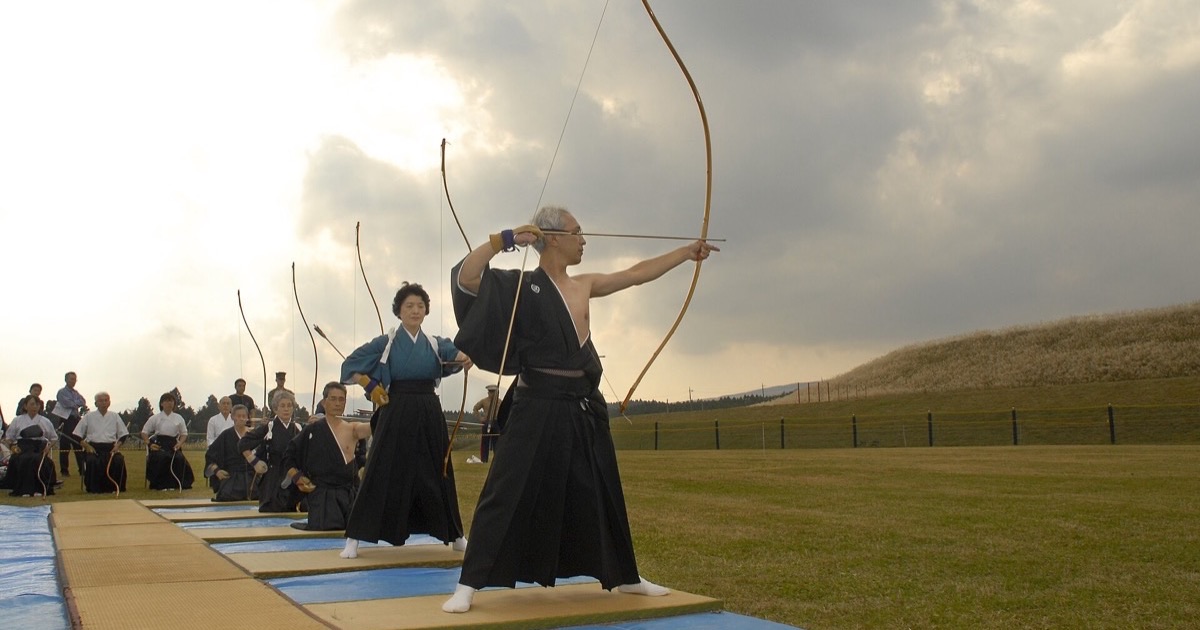
Why it was built this way is less certain. You will read theories involving shooting from horseback or kneeling, but we have not found a museum source that settles the question, so treat them as theories rather than history.
The grip shapes the technique too. The ANKF calls the way the left hand holds the bow tenouchi, and defines yugaeri as the moment "the Tsuru rotates to the back of the left hand" at release. In other words, a well-shot yumi turns in the hand after the arrow leaves.
Draw weight of Japanese bows
Kyudo sources usually describe draw weight in kilograms. OKO Kyudo Europe says: "A beginner uses a yumi with 7 - 12 kg. Advanced users have yumi with a draw weight of between 12 - 25 kg (sometimes even more)."
Multiplying by about 2.2 gives roughly 15–26 lb for beginners and 26–55 lb for advanced archers. Western recurves, by contrast, are marked in pounds at a 28-inch draw, so don't read too much into a straight comparison. Your own draw length still matters, and our draw length guide explains why.
Equipment also varies by school. OKO practises in the Chikurin-ha tradition, using bamboo arrows and a three-finger glove (kake), and it mentions four- and five-finger gloves in use elsewhere. A teacher at your dojo will advise on length and weight.
Kyudo vs Western archery
| Kyudo | Western target archery | |
|---|---|---|
| Bow | Yumi, standard 2.21 m (ANKF), gripped below centre | Recurve or compound, gripped near the middle |
| Draw weight | Usually kilograms (OKO: 7–12 kg for beginners) | Pounds, marked at a 28-inch draw on recurves |
| Standard distance | 28 m, called kinteki (ANKF) | Set by the round being shot |
| Target | 36 cm mato (Wikipedia) | Ten-ring face scoring 10 down to 1 |
| Main goal | Correct form; hits follow | Highest score |
The ANKF divides the shot into eight stages, the shaho hassetsu, from footing (ashibumi) to zanshin, the state of body and mind just after release. It describes the ideal of "truth, goodness, beauty" (shin-zen-bi) and the saying seisha hitchu: an arrow shot with correct form will hit. The ANKF even has a word, ateyumi, for an archer "concerned mainly with hitting the Mato" while ignoring the basics.
Western target archery scores rings instead, as our archery scoring guide explains. For more on other traditional bows, see our longbow vs recurve comparison.
If you want to read up first, you can browse kyudo books on Amazon or see yumi listings. Treat listings as examples to consider, and ask your teacher before buying a bow.
Frequently asked questions
Why are Japanese longbows asymmetrical?
The yumi is gripped in its lower third, so the upper limb is longer than the lower one. Several explanations are offered, including shooting from horseback or kneeling, but none is confirmed by a museum source we have found. What is certain is that modern kyudo technique is built around that grip.
What draw weight is a beginner yumi?
OKO Kyudo Europe says beginners use a yumi of 7 to 12 kg, which is roughly 15 to 26 lb. Advanced archers use 12 to 25 kg or more. Schools and teachers differ, so ask your dojo before choosing, and pick a weight you can draw smoothly through all eight stages.
What is the difference between archery and kyudo?
Kyudo is Japanese archery with the yumi. It uses a standard 28-metre distance and a small target, but it puts the form of the shot first, following eight set stages. Western target archery uses recurves or compounds and ranks archers by score, although good form matters there too.
Related articles
 Comparisons
Longbow vs Recurve Bow: Differences for Traditional Archers
Longbow vs recurve compared: limb shape, draw feel, hand shock, speed, length, accessories, competition rules, hunting and which traditional bow suits you.
Updated September 30, 2026 · 6 min read
 Guides
How Archery Scoring Works: Target Faces, Rings and Match Rules
How archery scoring works: ring values and colours, target face sizes, line cutters, X counts, the recurve set system, compound matches and shoot-offs.
Updated September 14, 2026 · 8 min read
 Guides
How to Choose Your First Recurve Bow: A Beginner's Guide
How to choose a first recurve bow: takedown vs one-piece, draw weight, bow length for your draw length, riser types, eye dominance, and essential accessories.
Updated February 6, 2025 · 11 min read