
Can You Use a Golf Rangefinder for Bowhunting?
Can you use a golf range finder for bow hunting? Yes on level ground. How golf and hunting modes differ: target priority, slope vs true horizontal distance.
By Archery Insider Editorial Team
· · 5 min read
In this article
Yes, you can use a golf rangefinder for bowhunting, and on level ground it gives a perfectly usable line-of-sight yardage. The limits show up in two places: golf units are tuned to lock onto a flag, not a deer behind brush, and their slope numbers are golf "play as" distances rather than the true horizontal distance a bowhunter needs from a tree stand.
Golf modes vs hunting modes
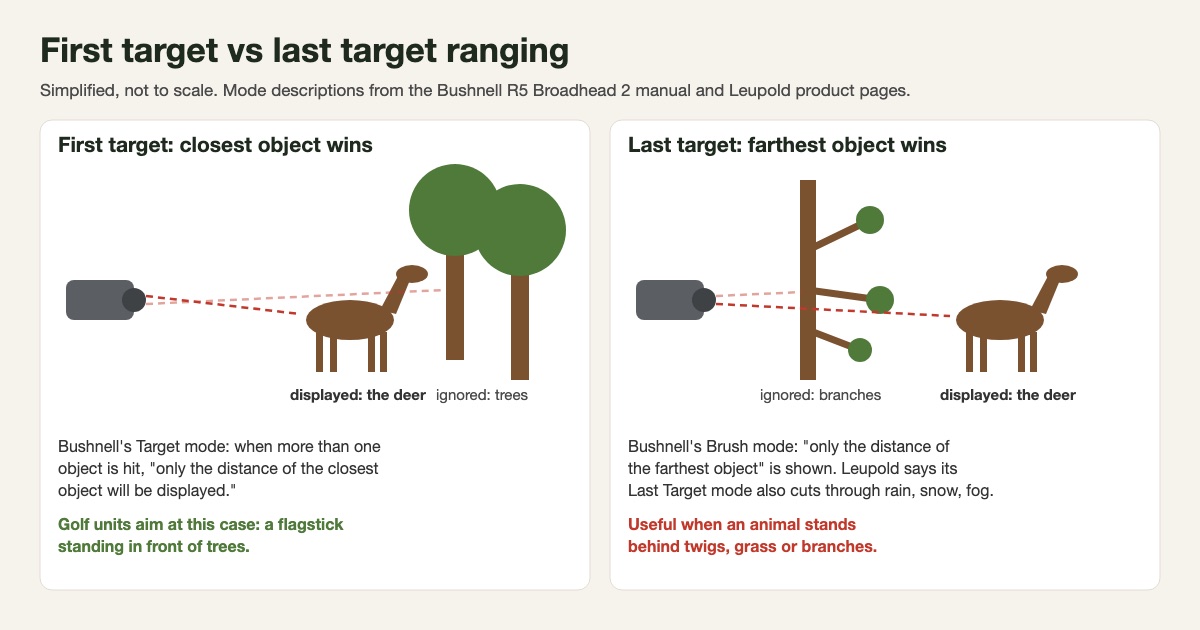
A laser often gets more than one return: a flag and the trees behind it, or a branch and the deer beyond it. What it displays depends on its target priority.
Golf units are designed around the flagstick. Bushnell Golf says PinSeeker uses vibration "to let you know when you've locked onto the flag, and only the flag." Leupold says its GX-2c Flag Lock "ensures that the laser will lock onto the pin instead of any hazards around it - like tree branches or bushes." Vortex says the PinSpotter mode on its Blade Slope gives visual and vibratory feedback once it locks onto the pin.
Bowhunting units give you a choice. The Bushnell R5 Broadhead 2 manual describes a Target mode in which "only the distance of the closest object will be displayed," and a Brush mode in which "only the distance of the farthest object" is shown, so branches in front are ignored. Leupold's RX-FullDraw 5 has a Last Target setting that picks "the most distant target along the laser's trajectory." Its GX-2c golf spec sheet lists Last Target as "No."
| Feature | Golf examples we read | Bowhunting examples we read |
|---|---|---|
| Target priority | Pin lock (PinSeeker, Flag Lock, PinSpotter) | Closest and farthest-object modes (Bushnell); Last Target (Leupold) |
| Angle output | Slope "play as" distance, switchable off for tournaments | Line of sight plus true horizontal distance |
| Bad weather | Vortex Golf advises taking several readings in fog or rain | Bushnell Fog Mode; Leupold Last Target for rain, snow and fog |
| Stated accuracy at bow range | Leupold GX-2c: 0.5 yd to 125 yd | Leupold RX-FullDraw 5: 0.5 yd to 125 yd; Bushnell Broadhead 2: ±0.3 yd to 150 yd |
Angle compensation
From a tree stand or on a steep slope, the straight-line distance to an animal is longer than the horizontal distance your sight pins are set for. Bushnell's manual says hunters "have struggled with extreme uphill and downhill angles because these angles alter true horizontal distance." In Bow Mode, the Broadhead 2 shows the line-of-sight distance plus "the degree of incline, and the resulting true horizontal distance."
Leupold's buying guide describes its standard BOW mode as calculating "angle compensated ranges out to 175 yards," while its LOS mode ignores incline.
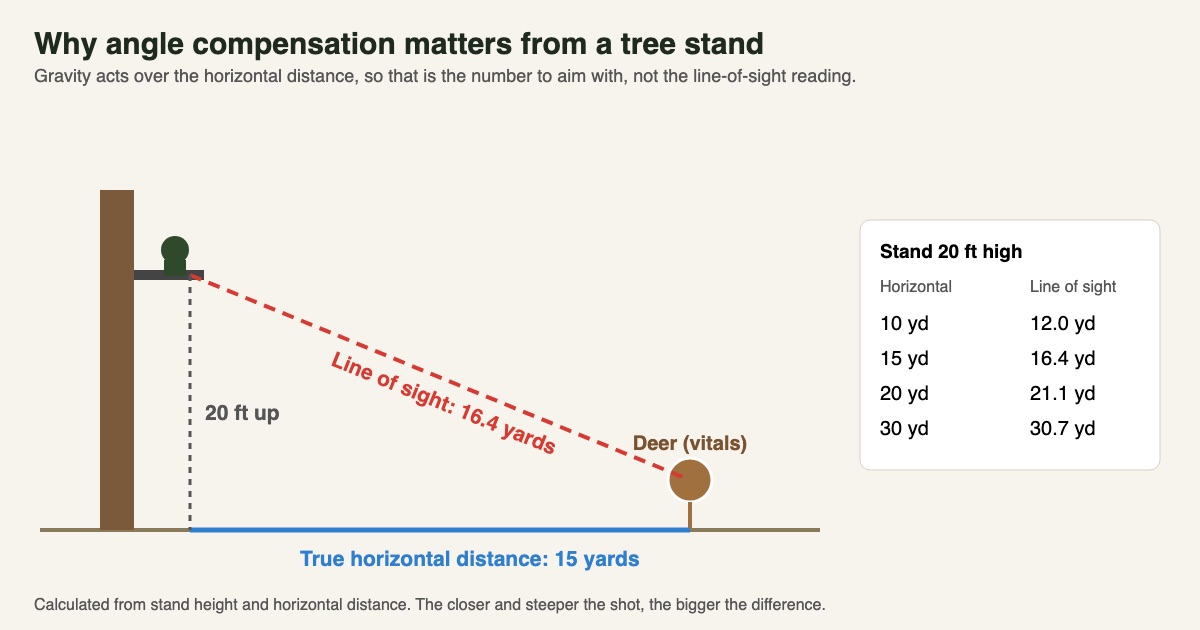
Golf slope modes also adjust for elevation, but for a different job. Bushnell Golf describes its Slope numbers as "play as" distances, and Leupold's True Golf Range "uses inclines/declines, temperature, and altitude" to recommend a club. Neither maker describes these as true horizontal distance, so don't use a golf slope reading to pick a sight pin. Use the line-of-sight mode, and remember it reads long on steep angles.
When a golf unit is fine
A simple decision rule:
- Fine: ground blinds and flat terrain, open shooting lanes, ranging trees or markers before the animal arrives, and 3D or backyard practice.
- Better with a bowhunting unit: tree stands, steep hillsides, animals standing in brush, and rainy or foggy mornings.
Whichever unit you carry, know your limit; our guide to effective bow range for deer explains why. Steep angles also change the shot, as our deer shot placement guide shows. Rules on electronic devices while hunting vary, so check your state's regulations before the season.
You can browse archery rangefinders with angle compensation on Amazon or compare golf rangefinders with slope. Examples to consider include the Bushnell R5 Broadhead 2 and Leupold RX-FullDraw 5.
Frequently asked questions
Can you use a golf range finder for bow hunting?
Yes. On level ground, a golf rangefinder's line-of-sight reading is the distance you need, and Leupold lists the same short-range accuracy for its golf and archery units. But golf units lack the bow modes that report true horizontal distance from a stand, and they're tuned to lock onto flags.
What is the difference between a golf and a hunting rangefinder?
Mainly target priority and angle output. Golf units lock onto the flagstick and give slope-adjusted "play as" distances. Bowhunting units such as Bushnell's Broadhead 2 add closest-object and brush modes, plus a bow mode that shows the incline and true horizontal distance alongside line of sight.
Do I need angle compensation for bowhunting?
It matters most from tree stands and on steep ground, where the straight-line distance is longer than the horizontal distance your pins are set for. Bushnell and Leupold both build bow modes that calculate it for you.
Related articles
 Gear
How to Choose a Rangefinder for Bowhunting
How to choose a bowhunting rangefinder: angle compensation, bow modes, scan and target priority, display, magnification, bow-mounted units and field use.
October 11, 2026 · 9 min read
 Guides
How Far Can You Shoot a Deer With a Bow?
Effective bow range for deer: what bowhunter education says, why long shots wound more, arrow flight times, jumping the string, and how to find your limit.
October 7, 2026 · 9 min read
 Guides
Where to Shoot a Deer With a Bow: Shot Placement
Bow shot placement for deer: where the heart and lungs sit, how to aim broadside, quartering away and from a tree stand, which shots to pass on, and why.
October 6, 2026 · 10 min read