
Glue-On vs Screw-In Broadheads
Glue-on vs screw-in broadheads: how glue on broadheads fit tapered wood arrows, how screw-ins use inserts, hot-melt safety, carbon cautions and spin testing.

By Archery Insider Editorial Team
· 5 min read
In this article
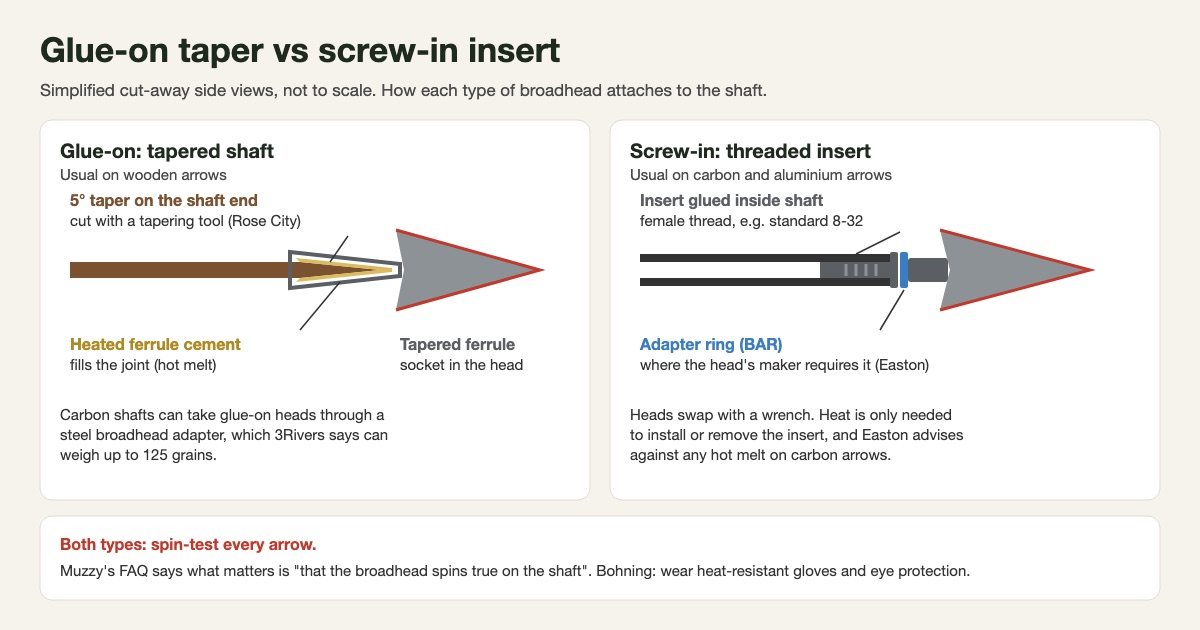
Glue-on broadheads slide over a tapered shaft end and are fixed with heated ferrule cement, the usual choice for wooden arrows. Screw-in broadheads thread into an insert glued inside a carbon or aluminium shaft, so heads swap with a wrench. Pick the type your shaft is built for, then spin-test every arrow.
Glue-on heads and taper adaptors
A glue-on head has a hollow, cone-shaped ferrule. Rose City Archery says that on a wooden arrow you "must cut a five-degree taper on the end of the shaft" with a tapering tool. The head slides over that taper.
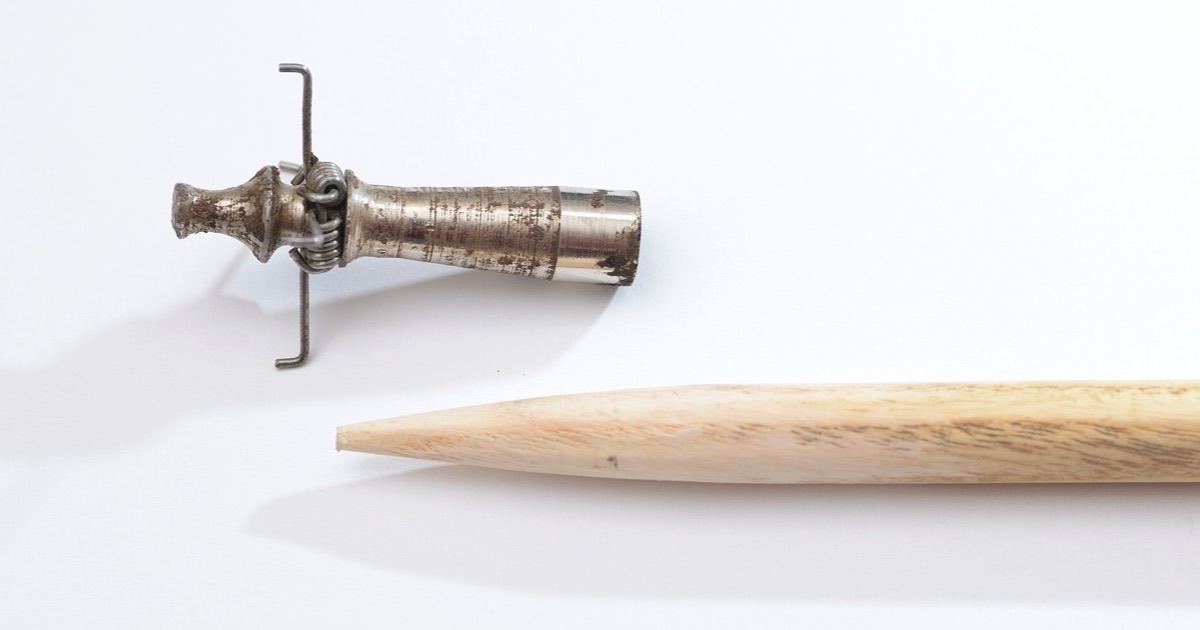
Carbon shafts can take glue-on heads too, through an adaptor. 3Rivers says solid steel adapters "allow the use of glue-on broadheads" and "can themselves weigh up to 125 grains." That weight moves the balance point forward, so recheck spine. Our wood arrows guide covers why many traditional archers still shoot wood.
The hot-melt method
Rose City says to use "a ferrule cement that is heated to form the adhesion between shaft and point." Bohning's instructions for its Ferr-L-Tite hot melt run like this:
- Wear heat-resistant gloves and eye protection. Bohning warns: "Do not touch hot surfaces or adhesives with bare skin."
- Heat the stick over a small flame "until the adhesive glosses over".
- Apply it all the way round, then press the part home "while rotating it one complete turn".
- Check alignment before it sets. Rose City: "always check for accurate alignment of all components."
Bohning recommends standard Ferr-L-Tite for wood and Cool Flex for carbon, which "can be reversed without damaging your arrow." Easton is stricter: "Because heat will damage the structure of carbon shafts and should always be avoided, Easton Archery does not recommend any type of hot melt glue for any carbon arrows." Follow your shaft maker's advice.
Screw-in heads with inserts
A screw-in head has a threaded stud that screws into an insert glued inside the shaft. Easton notes that some fixed heads also need a broadhead adapter ring: "Broadhead Adapter Rings are required for fixed broadheads that utilize the face of the insert to support or hold the blades in place."
Once the insert is set, heads change without heat, which makes screw-ins the easy choice on carbon.
Glue-on vs screw-in at a glance
| Glue-on | Screw-in | |
|---|---|---|
| Usual shaft | Wood with a 5° taper; carbon with a taper adaptor | Carbon or aluminium with an insert |
| How it's fixed | Heated ferrule cement | Thread into the insert |
| Changing heads | Reheat to remove | Unscrew with a wrench |
| Heat near the shaft | Every fitting and removal | Only for the insert |
| Fixing a wobble | Warm and re-seat the head | Check the insert, ring and head |
The spin test
Muzzy's FAQ says what matters most is "that the broadhead spins true on the shaft and you use proper fletching." Spin the arrow on a spin tester or balanced on its tip; a true head runs smoothly, while a wobble shows a crooked joint.
With a glue-on, you can usually warm the ferrule and re-seat it. With a screw-in, check the insert sits square and the head is tight, and swap heads to find the fault. For choosing the head itself, see our fixed-blade vs mechanical broadheads comparison or our broadheads for traditional bows guide.

For examples to consider, you can browse glue-on broadheads on Amazon or look at hot-melt ferrule cement. Match the taper or thread to your shaft first.
Frequently asked questions
Can you put glue-on broadheads on carbon arrows?
Yes, with a broadhead adapter fitted to the shaft. 3Rivers says solid steel adapters allow glue-on heads and can weigh up to 125 grains. Heat can damage carbon, so follow your shaft maker's adhesive advice. Easton doesn't recommend any hot melt on carbon arrows, and Bohning suggests Cool Flex for carbon.
What glue do you use for glue-on broadheads?
Most archers use a hot-melt ferrule cement. Rose City Archery describes "a ferrule cement that is heated" for wooden shafts, and Bohning recommends its standard Ferr-L-Tite for wood. Heat the stick until it glosses over, coat the taper, then twist the head on and check alignment before the cement sets.
How do you remove a glue-on broadhead?
Heat softens hot-melt cement, so the head comes off once it is warm. On carbon with standard Ferr-L-Tite, Bohning says to put flame only on the point for 7 to 10 seconds, then remove it with pliers without gripping the shaft. With Cool Flex, it suggests boiling water for 10 to 15 seconds. Wear heat-resistant gloves.
Related articles
 Gear
Wood Arrows: Pros, Cons and Who Shoots Them
Carbon arrows vs wood arrows: what cedar and other wooden arrows do well, where spine and weight vary, how to inspect them, and who should shoot them.
Updated October 6, 2026 · 5 min read
 Gear
Broadheads for Traditional Bows: What Works
Traditional bow broadheads: why two-blade cut-on-contact heads suit recurves and longbows, plus head weight, FOC, sharpening, mechanicals and legal minimums.
Updated October 6, 2026 · 5 min read
 Comparisons
Fixed-Blade vs Mechanical Broadheads: Pros, Cons and Rules
Fixed-blade vs mechanical broadheads compared: flight, tuning, cutting diameter, energy needs, durability, hybrid designs, regulations and which suits your bow.
Updated October 9, 2026 · 6 min read